 Independent local guide
Recorded demo observation · virtual USD
Final crash: 1.1
Actual stake: 1
Actual gross return: 0
SPRIBE / AVIATOR / Egypt
A recorded SPRIBE demo sample, downloadable results and reproducible strategy replays for this Egyptian guide.
All strategy amounts below are hypothetical EGP, starting from 10,000 EGP. They are arithmetic replays, not money won in an Egyptian account and not a conversion of the demo USD balance.
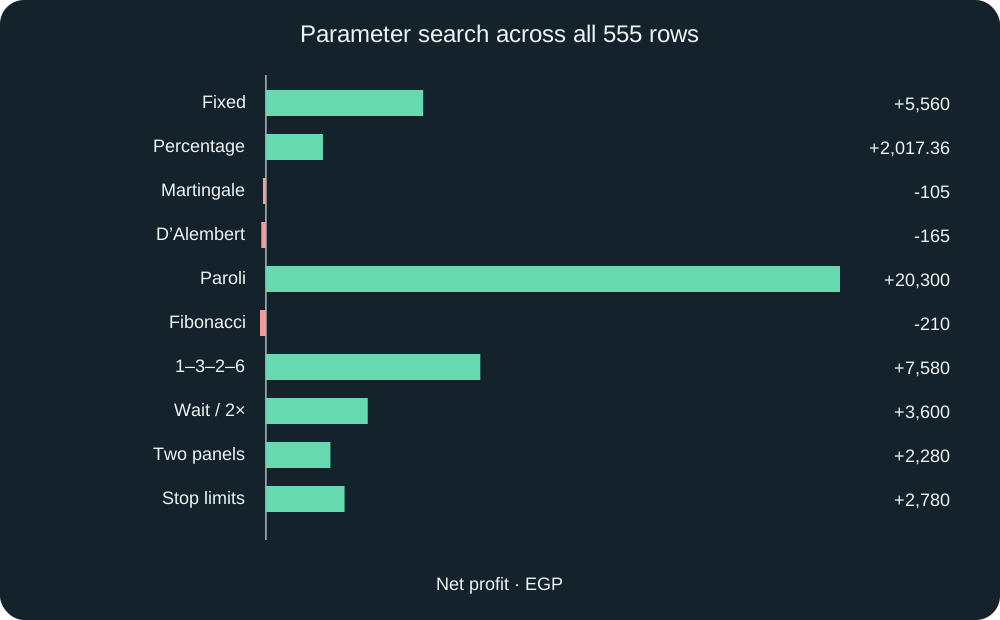
| Rule | Parameters | Net profit · EGP | Maximum drawdown | Bets placed | Stop reason |
|---|---|---|---|---|---|
| Fixed | Cashout multiplier: 4.7× · Base stake: 200 · Maximum stake: 12800 | +5,560 | 7,640 | 555 | Completed |
| Percentage | Cashout multiplier: 4.7× · Base stake: 100 · Maximum stake: 6400 · Bank percentage: 1.5 | +2,017.36 | 9,967.95 | 555 | Completed |
| Martingale | Cashout multiplier: 1.2× · Base stake: 25 · Maximum stake: 200 | -105 | 350 | 555 | Completed |
| D’Alembert | Cashout multiplier: 1.2× · Base stake: 25 · Maximum stake: 100 | -165 | 345 | 555 | Completed |
| Paroli | Cashout multiplier: 4.7× · Base stake: 200 · Maximum stake: 12800 · Winning steps: 5 | +20,300 | 10,860 | 555 | Completed |
| Fibonacci | Cashout multiplier: 1.2× · Base stake: 25 · Maximum stake: 100 | -210 | 355 | 555 | Completed |
| 1–3–2–6 | Cashout multiplier: 4.7× · Base stake: 200 · Maximum stake: 12800 | +7,580 | 11,920 | 555 | Completed |
| Wait / 2× | Cashout multiplier: 8.5× · Base stake: 200 · Maximum stake: 12800 · Consecutive rounds at or below 2×: 6 | +3,600 | 1,000 | 16 | Completed |
| Two panels | Cashout multiplier: 4.7× · Base stake: 200 · Maximum stake: 12800 · Second cashout: 5 | +2,280 | 7,720 | 555 | Completed |
| Stop limits | Cashout multiplier: 4.7× · Base stake: 100 · Maximum stake: 6400 · Stop loss (0 = off): 2000 · Take profit (0 = off): 8000 | +2,780 | 3,820 | 555 | Completed |
These settings were selected after seeing this sample. Their historical profit is not evidence of a future advantage.
| Rule | Parameters | Net profit · EGP | Maximum drawdown | Bets placed | Stop reason |
|---|---|---|---|---|---|
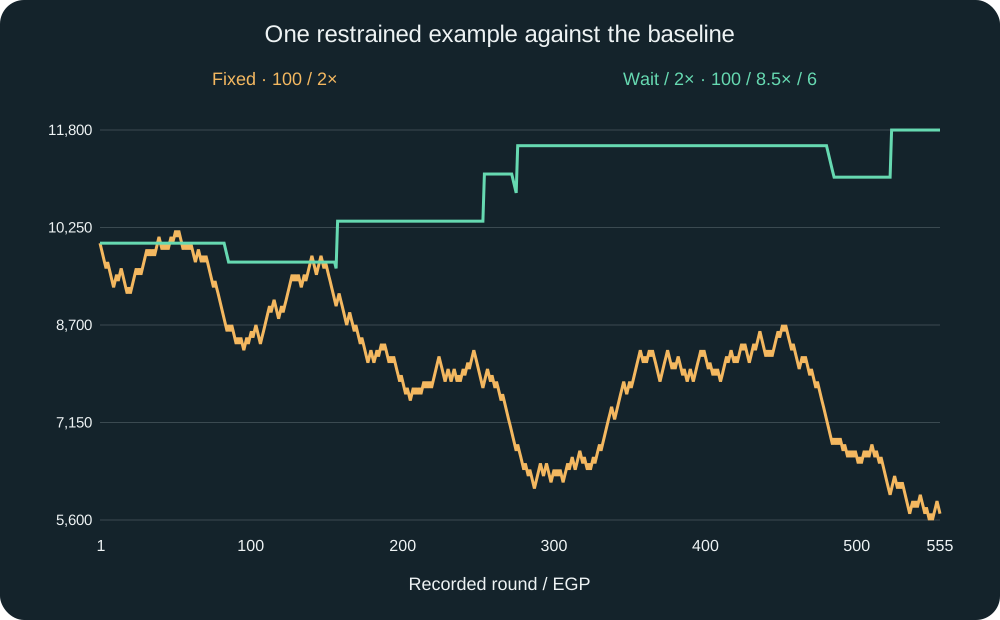
| Wait / 2× | Cashout multiplier: 8.5× · Base stake: 100 · Maximum stake: 6400 · Consecutive rounds at or below 2×: 6 | +1,800 | 500 | 16 | Completed |
| Rule | Parameters | Net profit · EGP | Maximum drawdown | Bets placed | Stop reason |
|---|---|---|---|---|---|
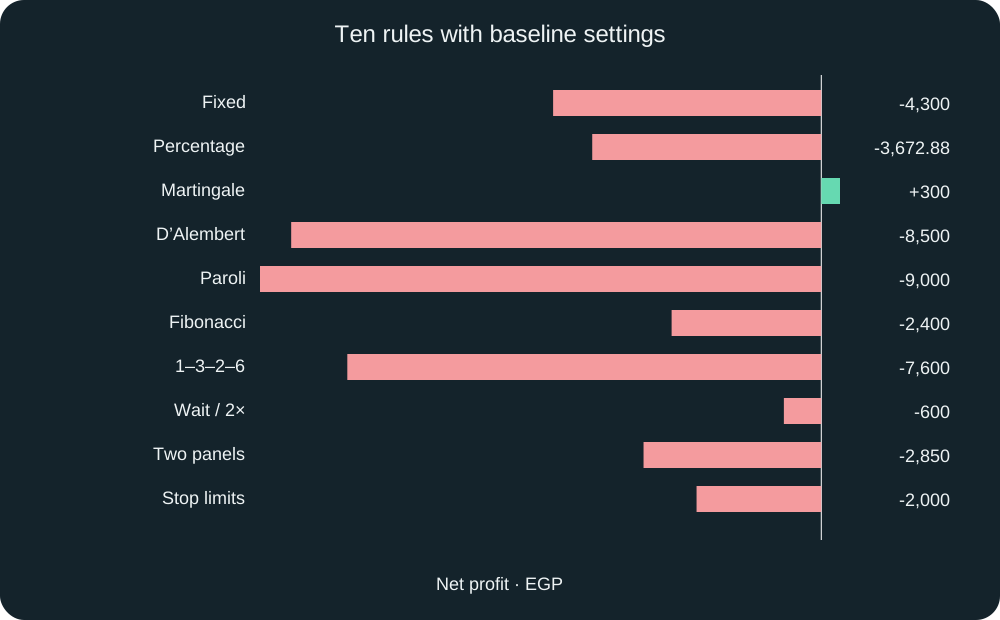
| Fixed | Cashout multiplier: 2× · Base stake: 100 · Maximum stake: 1600 | -4,300 | 4,600 | 555 | Completed |
| Percentage | Cashout multiplier: 2× · Base stake: 100 · Maximum stake: 1600 · Bank percentage: 1 | -3,672.88 | 3,910.78 | 555 | Completed |
| Martingale | Cashout multiplier: 2× · Base stake: 100 · Maximum stake: 1600 | +300 | 3,100 | 75 | Stake cap |
| D’Alembert | Cashout multiplier: 2× · Base stake: 100 · Maximum stake: 1600 | -8,500 | 11,200 | 83 | Insufficient bank |
| Paroli | Cashout multiplier: 2× · Base stake: 100 · Maximum stake: 1600 · Winning steps: 3 | -9,000 | 9,200 | 555 | Completed |
| Fibonacci | Cashout multiplier: 2× · Base stake: 100 · Maximum stake: 1600 | -2,400 | 3,300 | 80 | Stake cap |
| 1–3–2–6 | Cashout multiplier: 2× · Base stake: 100 · Maximum stake: 1600 | -7,600 | 9,000 | 555 | Completed |
| Wait / 2× | Cashout multiplier: 2× · Base stake: 100 · Maximum stake: 1600 · Consecutive rounds at or below 2×: 3 | -600 | 1,000 | 86 | Completed |
| Two panels | Cashout multiplier: 1.5× · Base stake: 100 · Maximum stake: 1600 · Second cashout: 3 | -2,850 | 3,225 | 555 | Completed |
| Stop limits | Cashout multiplier: 2× · Base stake: 100 · Maximum stake: 1600 · Stop loss (0 = off): 2000 · Take profit (0 = off): 1000 | -2,000 | 2,200 | 196 | Loss limit |
| Rule | Parameters | Rows 1–333 | Rows 334–555 | Stop reason |
|---|---|---|---|---|
| Fixed | Cashout multiplier: 4.7× · Base stake: 200 · Maximum stake: 12800 | +3,900 | +1,660 | Completed |
| Percentage | Cashout multiplier: 4.7× · Base stake: 100 · Maximum stake: 6400 · Bank percentage: 1.5 | +1,638.56 | +325.64 | Completed |
| Martingale | Cashout multiplier: 1.2× · Base stake: 25 · Maximum stake: 200 | -95 | -10 | Completed |
| D’Alembert | Cashout multiplier: 1.2× · Base stake: 25 · Maximum stake: 100 | -95 | -70 | Completed |
| Paroli | Cashout multiplier: 4.7× · Base stake: 200 · Maximum stake: 12800 · Winning steps: 3 | +9,880 | +1,880 | Completed |
| Fibonacci | Cashout multiplier: 1.2× · Base stake: 25 · Maximum stake: 100 | -105 | -105 | Completed |
| 1–3–2–6 | Cashout multiplier: 4.7× · Base stake: 200 · Maximum stake: 12800 | +7,060 | -2,300 | Completed |
| Wait / 2× | Cashout multiplier: 9.5× · Base stake: 200 · Maximum stake: 12800 · Consecutive rounds at or below 2×: 3 | +4,200 | -2,400 | Completed |
| Two panels | Cashout multiplier: 4.7× · Base stake: 200 · Maximum stake: 12800 · Second cashout: 5 | +2,650 | -370 | Completed |
| Stop limits | Cashout multiplier: 4.7× · Base stake: 200 · Maximum stake: 12800 · Stop loss (0 = off): 4000 · Take profit (0 = off): 4000 | +3,900 | +4,320 | Profit limit |
For each family we selected its best complete configuration on rows 1–333. We then replayed those settings unchanged on rows 334–555 with a fresh 10,000 bank and reset signal. Three families finished the later section in profit; a fourth was profitable but stopped at its profit limit. Six lost money. This is a retrospective chronological check, not a new live experiment. It tests a different selection procedure from choosing the full-history winner; neither should be confused with reliable income.
| Rule | Parameters | Net profit · EGP | Maximum drawdown | Bets placed | Stop reason |
|---|---|---|---|---|---|
| Wait / 2× | Cashout multiplier: 8× · Base stake: 100 · Maximum stake: 6400 · Consecutive rounds at or below 2×: 5 | +1,400 | 800 | 26 | Completed |
| Wait / 2× | Cashout multiplier: 8× · Base stake: 100 · Maximum stake: 6400 · Consecutive rounds at or below 2×: 6 | +1,600 | 500 | 16 | Completed |
| Wait / 2× | Cashout multiplier: 8× · Base stake: 100 · Maximum stake: 6400 · Consecutive rounds at or below 2×: 7 | +600 | 400 | 10 | Completed |
| Wait / 2× | Cashout multiplier: 8.5× · Base stake: 100 · Maximum stake: 6400 · Consecutive rounds at or below 2×: 5 | +1,650 | 800 | 26 | Completed |
| Wait / 2× | Cashout multiplier: 8.5× · Base stake: 100 · Maximum stake: 6400 · Consecutive rounds at or below 2×: 6 | +1,800 | 500 | 16 | Completed |
| Wait / 2× | Cashout multiplier: 8.5× · Base stake: 100 · Maximum stake: 6400 · Consecutive rounds at or below 2×: 7 | +700 | 400 | 10 | Completed |
| Wait / 2× | Cashout multiplier: 9× · Base stake: 100 · Maximum stake: 6400 · Consecutive rounds at or below 2×: 5 | +1,000 | 900 | 26 | Completed |
| Wait / 2× | Cashout multiplier: 9× · Base stake: 100 · Maximum stake: 6400 · Consecutive rounds at or below 2×: 6 | +1,100 | 600 | 16 | Completed |
| Wait / 2× | Cashout multiplier: 9× · Base stake: 100 · Maximum stake: 6400 · Consecutive rounds at or below 2×: 7 | +800 | 400 | 10 | Completed |
Fixed stakes keep the same amount each time. Percentage staking recalculates the stake from the current bank. Martingale doubles after a losing bet; D’Alembert adds one base unit after a loss and subtracts one after a win. Fibonacci moves one position forward after losing and two back after winning. These rules alter how much is exposed; they do not change the recorded crash outcomes. A stake cap or insufficient balance ends a replay and is shown explicitly.
Paroli doubles after a net win and returns to the base stake after a loss or its chosen winning sequence. The 1–3–2–6 rule uses those four stake multiples after consecutive wins. Two panels split one total stake into two legs with separate cashout targets; they do not receive separate crash outcomes. Stop limits end a fixed-stake replay after its profit or loss threshold is crossed. The last bet can overshoot a threshold, so the limit is not an exact guaranteed exit balance.
The waiting rule checks only earlier recorded rows from the same session. After six consecutive crashes at or below 2×, it places a bet on the following recorded row. If low crashes continue, it can place more than one bet during the streak; this is not a cooldown rule. An unobserved gap resets the signal. At the fitted 8.5× target, a 100 EGP winning bet returns 850 including its stake, for +750 net; a losing bet costs 100. The example has four wins and twelve losses: 4 × 750 − 12 × 100 = +1,800.
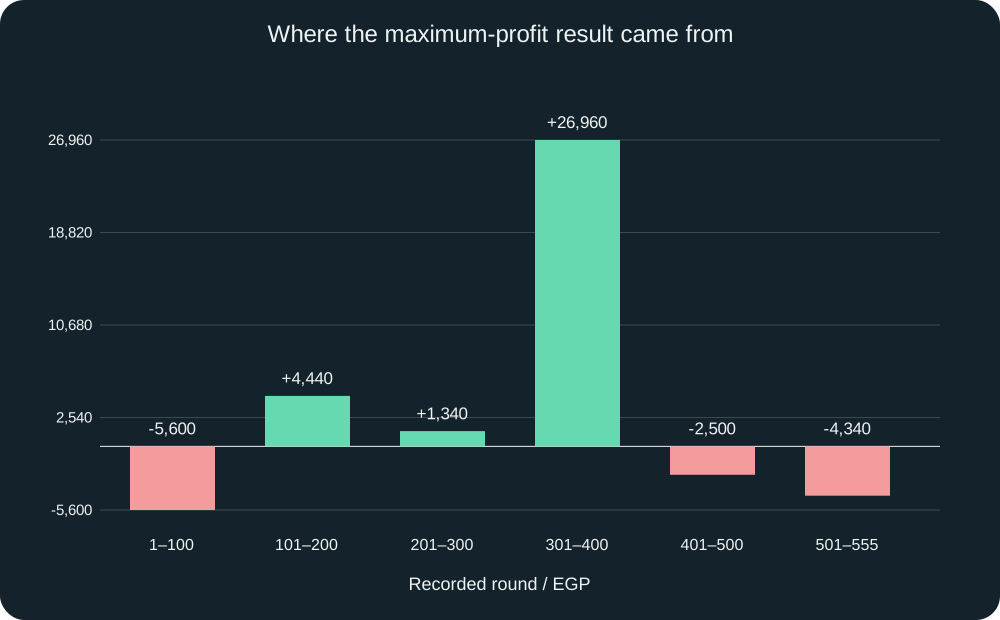
The best complete Paroli replay ends +20,300, yet the bank falls by as much as 10,860 from a previous peak. Drawdown is a peak-to-trough decline, not just the final loss or the initial stake. Its strongest 100-row block dominates the total, while three blocks are negative. A result can look impressive at the endpoint and still demand a path a reader would not tolerate. The smaller waiting example is shown on the bank chart so the maximum-profit line does not flatten every other comparison.
We checked ten rule families over cashout targets from 1.05× to 10×, base stakes 25, 50, 100, 150 and 200, and strategy-specific progression caps, percentages, waiting lengths, winning steps, second cashouts and stop thresholds. The grid download contains the exact combinations. We ranked full-history results by net profit only among runs that reached all 555 rows without a stop; ties prefer lower drawdown. A rule that stopped in profit after 78 bets is not called a winner across all 555.
For each family we selected its best complete configuration on rows 1–333. We then replayed those settings unchanged on rows 334–555 with a fresh 10,000 bank and reset signal. Three families finished the later section in profit; a fourth was profitable but stopped at its profit limit. Six lost money. This is a retrospective chronological check, not a new live experiment. It tests a different selection procedure from choosing the full-history winner; neither should be confused with reliable income.
The sensitivity table changes the restrained example’s target to 8×, 8.5× or 9× and its waiting length to five, six or seven. The stake stays 100. Check both net profit and bet count: a positive total based on a handful of bets is weak evidence. Nearby profitable settings can share the same rare winning events, so they are not nine independent confirmations. The downloadable rows let you inspect exactly which events drive a result.
Choose a rule and enter its cashout, starting bank, base stake and maximum stake. Percentage, winning steps, waiting length and second target only affect the relevant rule. Stop thresholds are applied when nonzero. The tool replays this fixed history in your browser; it neither connects to the game nor places bets. Compare a net result with drawdown, bets and stop reason, and keep the actual observed demo result separate from your hypothetical calculation.
All strategy amounts below are hypothetical EGP, starting from 10,000 EGP. They are arithmetic replays, not money won in an Egyptian account and not a conversion of the demo USD balance.
Resuming requires a stop loss above zero. Skip the chosen number of recorded rows without betting, then reset progression and waiting signals and measure the next stop loss from the remaining bank. No money is added and previous losses remain. Take profit stays relative to the original bank. Unobserved gaps are not counted as rows; paused rows do not build a waiting signal.
To reproduce the search, download rounds.json, replay.js, grid.mjs and reproduce.mjs with their full filenames into one folder, then run node aviator-eg-reproduce.mjs. Check file integrity against checksums.json.
rounds.json · rounds.csv · analysis.json · search.json · search.csv · replay.js · grid.mjs · reproduce.mjs · checksums.jsonInspect any of the 555 recorded rows using the current Playground settings. The left-hand evidence is the actual 1 virtual USD / 1.5× demo observation; the strategy result is a separate hypothetical EGP replay. No new game is running.
Final crash: 1.1
Actual stake: 1
Actual gross return: 0
The rule placed a bet. Its stake and target were set before reading this row’s crash.
Bank before this row: 5,800
Net result: -100
Bank after this row: 5,700
The previous-results chips are context, not a prediction. A displayed crash is the final outcome, not a value available when the bet was chosen. Use the slider or type a row number; the explanation follows the selected strategy, including pauses and early stops.
We compared 96 declared scenarios on these same 555 rows: two rules, stakes 50/100/200, loss limits 500/1,000/2,000, and pauses of 1/5/10/20 recorded rows. No further outcomes were collected. This checks how exposure changes on known history; it is not a fresh validation of profitability.
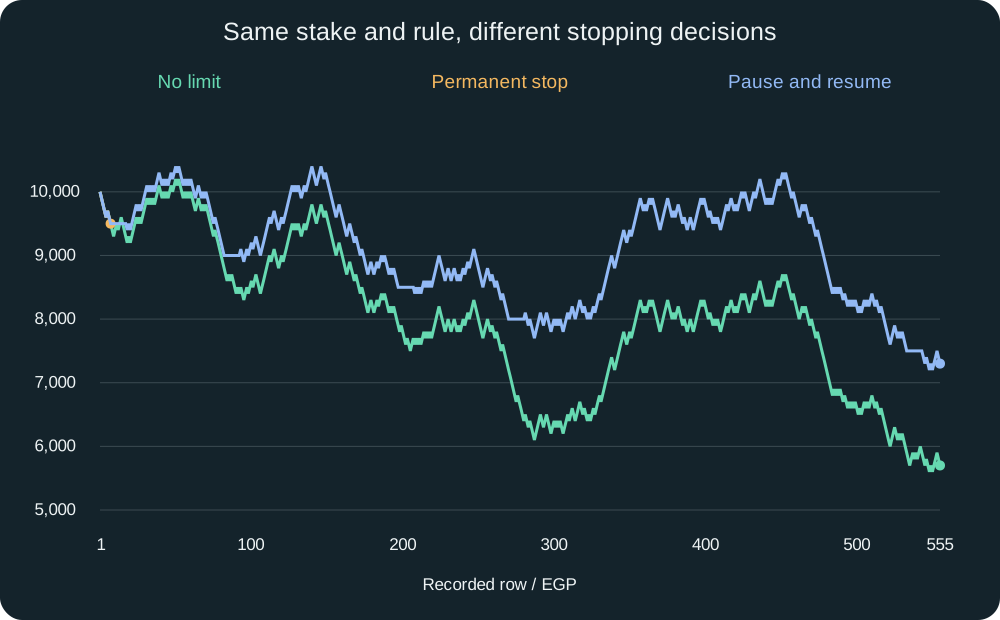
The loss limit is measured from the starting bank of the current betting period. It is not a trailing limit from the highest balance. At resumption, the loss baseline moves to the remaining bank, progression and waiting signals reset, and past losses remain. Paused rows do not build a waiting signal. Take profit is disabled in every comparison. Each loss can overshoot its limit by the last bet. A session boundary resets signals and progression but does not reset this loss baseline or replenish the bank.
Swipe the table horizontally to see every column.
| Stopping behaviour | Rows skipped per pause | Net result | Change from no limit | Maximum drawdown | Bets | Loss-limit hits | Missed winning bets | Avoided losing bets |
|---|---|---|---|---|---|---|---|---|
| No limit | Not applicable | -4,300 | 0 | 4,600 | 555 | 0 | 0 | 0 |
| Permanent stop | Not applicable | -500 | +3,800 | 500 | 7 | 1 | 255 | 293 |
| Pause and resume | 1 | -4,100 | +200 | 4,500 | 547 | 8 | 3 | 5 |
| Pause and resume | 5 | -3,600 | +700 | 4,000 | 520 | 7 | 14 | 21 |
| Pause and resume | 10 | -2,700 | +1,600 | 3,200 | 505 | 5 | 17 | 33 |
| Pause and resume | 20 | -2,500 | +1,800 | 3,000 | 455 | 5 | 41 | 59 |
For these fixed-stake rules, the difference from the no-limit replay is exactly the losing stakes avoided minus the net winnings missed. “Missed winning bets” counts hypothetical winning bets skipped by the changed rule, not money owed. Waiting-state resets can also skip otherwise eligible bets after a pause; those missed bets are included.
With fixed 2×, stake 100, limit 500 and pause 10, the replay skipped 17 winning bets (+100 each) and 33 losing bets (−100 each). Avoiding 3,300 of losses while missing 1,700 of net wins improved the final net by 1,600: −4,300 became −2,700. It still did not become profitable.
Use the selectors to compare all declared conditions. Similar final profits can conceal very different bet counts and drawdowns. Zero stop-loss hits means the control never acted; it cannot explain that replay’s outcome.
Download all 96 scenarios